Rubik's Cube Mathematical Explanation
- Techno girl :)
- Dec 27, 2017
- 4 min read
Hello my fellow’s mind geeks!
“If you are curious, you’ll find the puzzles around you. If you are determined, you will solve them. ” Erno Rubik
History of Rubik’s Cube
I do not know about you people but I love knowing the history off all the new things I learn. Therefore, I thought I’d share this new knowledge with you.
Erno Rubik a young Professor of architecture in Budapest back in 1974, created a solid cube twisted and turned with colorful stickers on its sides that did not break or fall apart. This cube is the famous “Rubik’s Cube”.
As a teacher, Erno was always looking for new and exciting ways to present information, so he used the Cube’s first model to help explain to his students about spatial relationships (help us to explore the concept of where objects are in relationship to something else! E.g. a ball may be behind the chair, or under the table, or in the box.).
In 1979, Rubik Cube made its first step worldwide, when some mathematicians charmed by the cube took the Cubes to international conferences and a Hungarian entrepreneur took the cube to the Nuremberg Toy Fair. This was the beginning of the success of Rubik’s Cube.
Maths in Rubik’s Cube
You know so many people and of course mathematicians remain obsessed with Rubik’s cube puzzle from back in 80’s. The reason was the number of combination solutions that a simple 3x3 Rubik’s cube puzzle has. Can you imagine 43, 252, 003, 274, 489, 856, 000 combinations! This is amazing! I cannot remember the number or even say it!
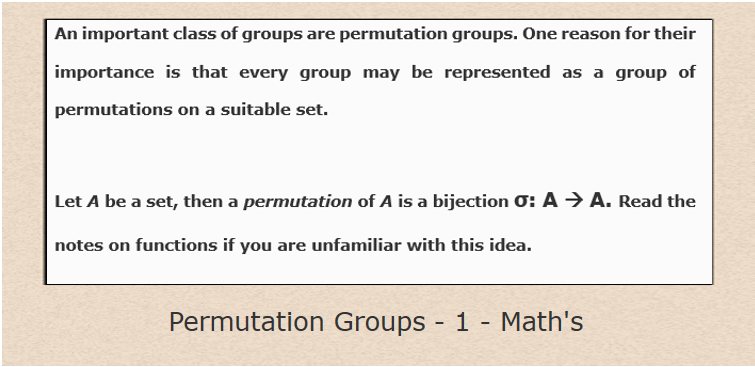
In mathematics and abstract algebra, group theory studies the algebraic structures known as groups and Rubik’s cube has been used as an illustration of permutation groups because it is an example of a group associated with it.
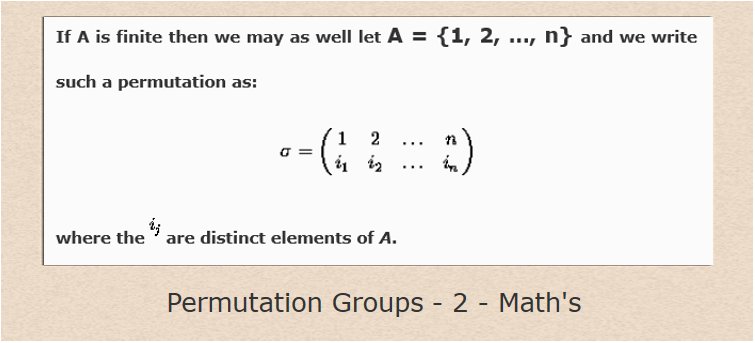
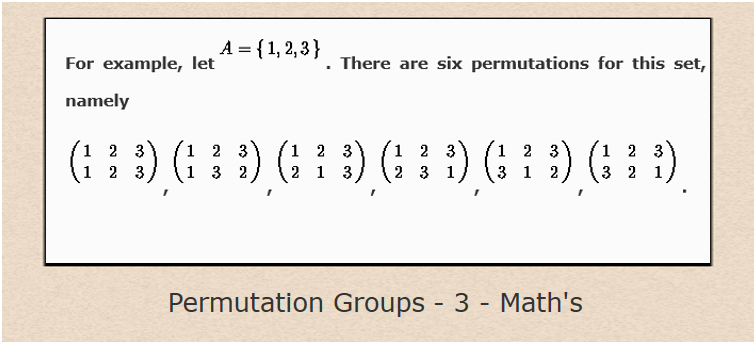
This group is the number of different combinations that there are the Rubik’s cube. It’s all the different ways that you can scramble up a cube. In the figures below, you will see an example of permutation groups.



Now if you have in front of you the Rubik cube (if you don’t just imagine that you are holding the cube), have a look the blue side of the cube and you will see a beautiful square, if you turn it you still have a square even when you flip it over you still have a square etc.
And as you understand this game has that symmetry. But before you try to solve this outstanding puzzle, you need to understand the moves or the spatial relationships, which are easy.

Please have a look at the image above; you see the Rubik’s cube notations. The same notations will be used to refer to face notation. For example, F means to rotate the front face 90 degrees clockwise. A counter clockwise rotation is denoted by lowercase letters (f) or by adding a‘ (F’).
A 180 degree turn is denoted by adding a superscript 2 (F2), or just the move followed by a 2 (F2). If you want to know which your color side is when your cube is mess up, just look the color at the center. For example, if you have green in center then you automatically know that we are in the green side. If you have red in the center you are in the red side of your cube.

Now, if you start counting the corners of the cube you will sum 8 corner "cubies" on a Rubik's Cube, each different. We can choose a location for each in 8 factorial ~ 8! ways (factorial = non-negative integer n, in our case 8! =8*7*6*5*4*3*2*1). Each of the 8 cubies can be turned in 3 different directions, so there are orientations altogether. The total number of ways the corner cubies can be placed is 8! * 3^8 .
By finishing the corner count and starting to count the edges cubies, which have 2 faces showing, there are 12 of these, so we can choose locations for them in 12 factorial ~12! ways (21*11* 10*…*2*1). Each edge piece has 2 possible orientations, so each permutation of edge pieces has arrangements. Thus, the total number of ways the edge cubies can be placed is 12! *2^12 .
Until now, we have: 8! * 3^8 * 12! * 2^8 = 519, 024, 039, 293, 878, 272, 000 possible arrangements of the pieces that make up the cube. However, these are not all valid as only 1 in 12 of these are actually solvable. And the reason is, that there is no sequence of moves that will swap a single pair of pieces or rotate a single corner or edge cube. Thus, there are twelve possible sets of reachable configurations, sometimes called "universes" or "orbits", where the pieces are able to move. This give us:

possible arrangements of the Rubik’s cube.
That’s it for today guys. Have a beautiful day or night!
In the mind time,
“Remember, we are all unique!”
Techno girl!
*See you next Thursday at 9pm!
Comments